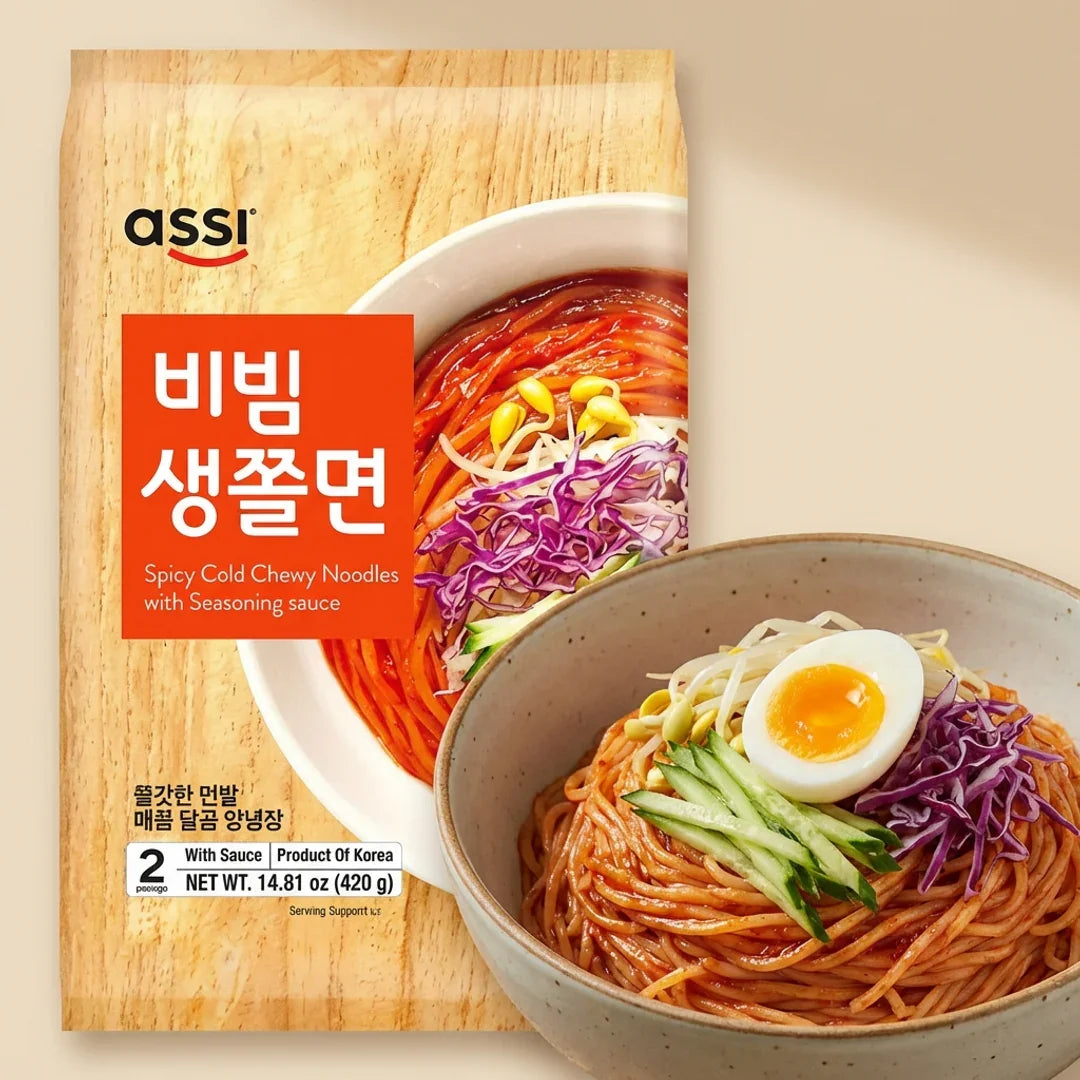
What is Jjolmyeon? Said to have originated in the 1970s at a noodle factory in Incheon, South Korea — where a batch of noodles was accidentally extruded thicker than usual — Jjolmyeon is a uniquely Korean noodle creation. Thicker than regular wheat noodles and springier than udon, its defining characteristic is an intensely chewy (jjolgit) texture that becomes more satisfying with every bite. The name itself comes from the Korean word meaning "chewy," and the dish has become one of the most iconic items in Korea's bunsik (street food snack) culture.
The heart of the bibim sauce: Gochujang. The bibim sauce in this product contains gochujang — Korea's traditionally fermented red pepper paste. Gochujang is made by combining meju (fermented soybean blocks), red pepper powder, glutinous rice, and salt, then naturally aging the mixture in earthenware jars over an extended period. During fermentation, deep umami and natural sweetness develop organically. Slowly maturing through the changing temperatures of the four seasons, its flavour grows richer and more complex over time.
A connection to European food culture. Just as cheese gains its depth of flavour by naturally fermenting milk, wine develops its complex aromas by ageing grapes, and sauerkraut achieves its pleasant tang by fermenting cabbage — Korean gochujang is likewise a time-honoured fermented food, crafted by naturally fermenting soybeans and grains. This is precisely why its spice carries not just heat, but a profound, lingering umami.