



Jump toRecipeStep by step
What is gochugaru (고춧가루) — and why does every Korean recipe seem to demand it? These vivid red chilli flakes bring warmth, colour and a gentle sweetness that ordinary chilli simply cannot copy. Stay with us, because we're also cooking the easiest gochugaru dish we know: glossy Korean braised tofu.

Gochugaru: the chilli that built Korean cooking
Here's a common worry. You've bought a bag of Korean chilli flakes, and now it stares at you from the cupboard. Is it fiery? Will one spoonful ruin dinner? Relax. Gochugaru sits at roughly 1,500–8,000 on the Scoville scale (approx.) — noticeably milder than cayenne. Consequently, you can use it by the tablespoon, not the pinch. It gives kimchi (김치) its red glow, tteokbokki (떡볶이) its blush, and countless stews their backbone. Moreover, it tastes of sun-dried fruit and smoke, not just heat. Once you understand that, the whole Korean pantry opens up.
So, what is gochugaru actually for in your kitchen? This post teaches two secrets. First, how to choose between coarse flakes and fine powder — they behave very differently in a pan. Second, how to bloom gochugaru in liquid rather than scorching it in hot oil, which is where most beginners go wrong. Then we put both lessons to work in dubu-jorim (두부조림), a braised tofu dish that Korean home cooks make on autopilot. It's cheap, quick and quietly addictive.

What is gochugaru, exactly?
Gochugaru (고춧가루) simply means "chilli powder" in Korean — gochu is chilli, garu is powder. It's made from a mild variety of Capsicum annuum, traditionally sun-dried (taeyangcho, 태양초), deseeded and ground. Because the seeds and pale membranes are removed, the flakes taste fruity and faintly sweet rather than harsh. Crucially, gochugaru is not gochujang (고추장); the latter is a fermented paste, while gochugaru is the dry flake that often goes into it. In Korean homes, a household's yearly kimchi depends on a good bag. We've seen grandmothers judge it by colour alone: deep red, never brown.
What you need for gochugaru braised tofu
The shopping list is short, and most of it lives happily in your cupboard for months. Coarse gochugaru is the star. If you only find fine powder, use it — the sauce will simply be smoother and slightly redder. No tofu? The same glaze works on pan-fried courgette or boiled eggs. For the soy, a lighter Korean soup soy sauce keeps the colour bright.
- : our go-to coarse gochugaru — fruity, mild and the classic texture for glazes and kimchi.
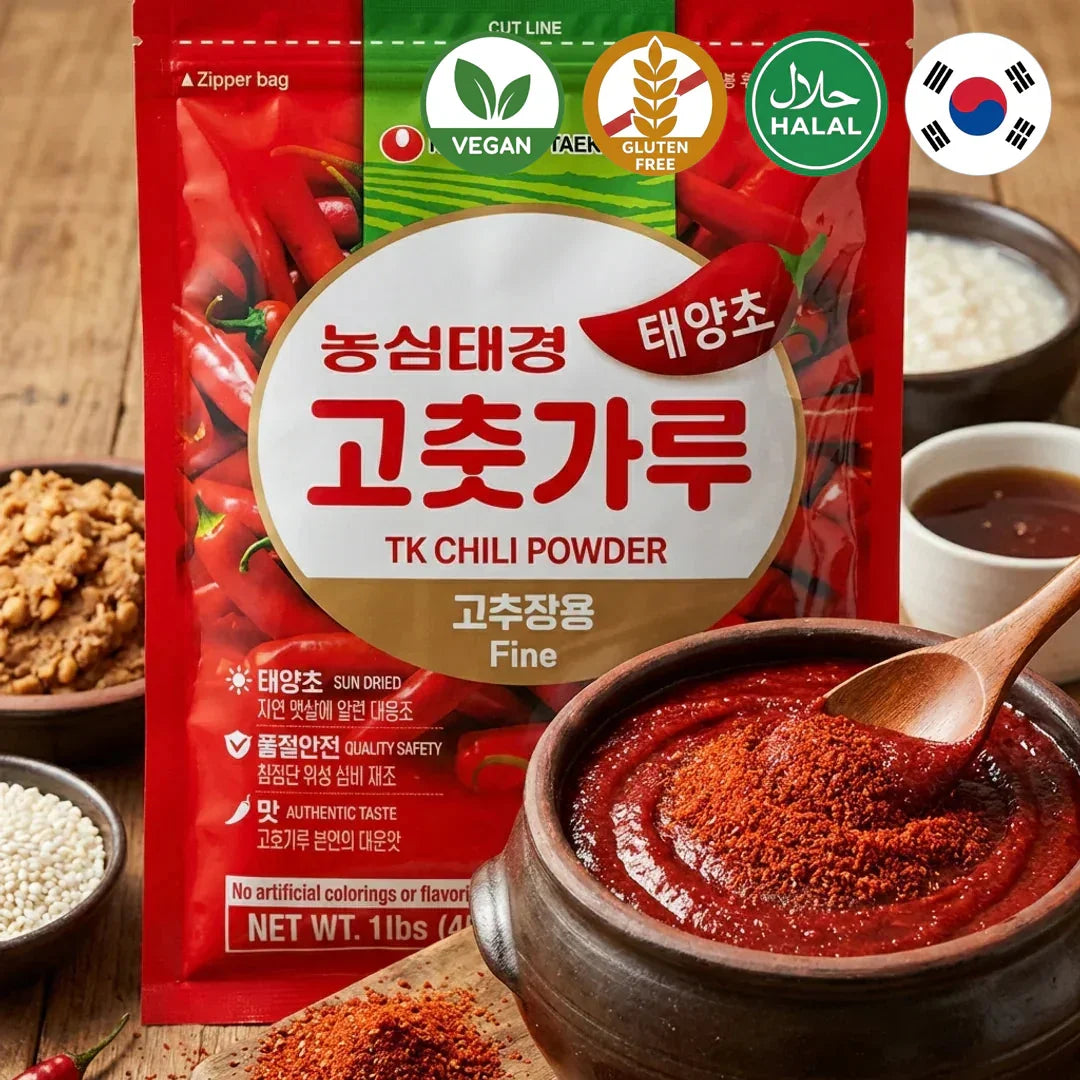
- : the fine grind; dissolves completely for silky, uniform sauces.
- : lighter and saltier than regular soy, so the glaze stays vivid red rather than turning brown.
- : one teaspoon lifts the whole sauce; double-strength, so a little goes far.
- : everyday staples from any European supermarket.

Technique and common mistakes
The one technique that matters: bloom gochugaru in liquid, never fry it hard in dry oil. Those beautiful flakes are delicate. In a screaming-hot pan they scorch within seconds, turning bitter and muddy brown. Instead, stir them into the soy, water and sugar first. Then let the sauce simmer gently around the tofu. The flakes soften, release their colour and stain the glaze a deep sunset red. This is exactly how Korean cooks build stews and braises. Once you've seen it work, you'll never dump gochugaru into hot oil again.
- *Dry the tofu properly**: Press it for 15 minutes and pat every surface. Dry tofu browns; wet tofu steams and sticks.
- *Bloom, don't burn**: Mix gochugaru into the liquid sauce before it meets the pan. Scorched flakes taste bitter and lose their colour.
- *Baste as it braises**: Spoon the sauce over the tofu every couple of minutes. That's how each slice ends up lacquered, not pale on top.
Tip: For extra depth, toast the gochugaru for just 20 seconds in the sesame oil off the heat — warm, not sizzling.
Step by step, in photos


What to serve with gochugaru braised tofu
Dubu-jorim is banchan (반찬) at heart — a shared side dish — but with rice it becomes a full meal. Accordingly, we serve it Korean-style: a bowl of hot rice, the tofu in the middle of the table, and one or two crunchy sides for contrast. Something pickled cuts through the rich glaze beautifully. Leftovers, incidentally, taste even better cold from the fridge the next day.
- CJ cooked rice — two minutes in the microwave and you have proper Korean short-grain rice under that glaze.
- pickled burdock and danmuji — cool, crunchy and sharp — exactly what the rich tofu wants beside it.
- Dongwon chilli tuna — an instant second banchan; spoon it straight over rice for a bigger spread.
Cook it once and gochugaru stops being a mystery — it becomes the bag you reach for without thinking. — DotAsia Kitchen x
More Korean recipes

Shop the ingredients
In stock · shipping across Europe
 Sempio 100% Sun-Dried Fine Chilli Powder 500g6.50 €Shop
 Taekyung Kimchi Red Pepper Powder 454g7.49 €Shop
 Hansung Chilli Powder for Kimchi 1kg11.75 €Shop
 Hansung Kimchi Red Pepper Flakes 2.5kg26.90 €Shop
 Sempio Soup Soy Sauce 860ml4.95 €Shop
 Baeksul Double-Strength Apple Vinegar 500ml3.29 €Shop
 CJ Hetbahn Cooked White Rice 210g2.10 €Shop
 Dongbaekha Salted Shrimp 500g (Frozen)9.79 €Shop

Gochugaru Braised Tofu (Dubu-jorim)
By: DotAsia Kitchen
Prep: 10 min·Cook: 20 min·Total: 30 min
Main course·Korean cuisine·Servings: 4
★★★★★A DotAsia house recipe
The best answer to what is gochugaru is to cook with it: this glossy braised tofu shows off its colour and gentle warmth in 30 minutes. Spice level: mild to medium.
Ingredients
Tofu
Gochugaru sauce
To finish
Method
- Drain the tofu and press it between kitchen paper under a heavy plate for 15 minutes. The drier it is, the better it browns.
- Cut the block into 1.5 cm slabs and pat them dry again. Sprinkle both sides lightly with salt.
- Stir the gochugaru, soy sauce, sugar, garlic, vinegar, water and half the spring onions in a bowl. Keep stirring until the sugar dissolves.
- Warm the vegetable oil in a wide frying pan over medium-high heat until it shimmers.
- Lay the slices in a single layer and fry for 3–4 minutes per side, until golden and crisp-edged. Work in batches if needed.
- Pour the sauce over and around the tofu. Bring it to a lively simmer, then lower the heat to medium.
- Simmer for 8–10 minutes, spooning the sauce over the tofu every couple of minutes, until it reduces to a glossy red glaze.
- Turn off the heat and drizzle over the sesame oil. Scatter with the remaining spring onions and sesame seeds, then serve with hot rice.
Notes
- Coarse or fine? Coarse flakes give texture; a fine grind like Sempio sun-dried fine chilli powder melts into a smoother, redder glaze. Both work here.
- Spice control: this recipe is mild-medium. Halve the gochugaru for children, or add ½ tsp more for a proper kick.
- Planning kimchi? Buy in bulk — the Hansung 2.5kg gochugaru bag works out far cheaper per 100 g.
- Storage: keeps 3 days in the fridge and tastes excellent cold. Reheat gently with a splash of water.
- Store gochugaru itself airtight in the freezer; the colour and aroma hold for a year or more.
- No gochugaru at all? Use sweet paprika with a pinch of cayenne — the colour survives, though the fruitiness won't.
Nutrition (per serving, approx.): Calories 210 kcal · Protein 13 g · Carbs 11 g · Fat 14 g
Did you make this recipe?
We love seeing your dishes — tag us on Instagram @dotasia.eu
Frequently asked questions
What is gochugaru made of?
Gochugaru is made from one thing: dried Korean red chillies, deseeded and ground. Traditionally the peppers are sun-dried (taeyangcho, 태양초), which develops a sweeter, fruitier flavour. There are no other ingredients — no salt, no oil. Check the label, though; good bags such as Sempio's sun-dried powder list only chilli.
What is gochugaru in English?
In English, gochugaru is usually called Korean red pepper flakes or Korean chilli powder. The word itself translates literally: gochu means chilli pepper and garu means powder. It's worth knowing both names, because European shops label it inconsistently — and standard "crushed chilli flakes" are not an equal swap.
What is the difference between gochugaru and gochujang?
They're different ingredients entirely. Gochugaru is a dry chilli flake; gochujang (고추장) is a thick, fermented paste made from chilli, rice and soybeans. Gochujang tastes deeper, sweeter and saltier, while gochugaru is brighter and cleaner. Many Korean recipes, including kimchi and this braised tofu, need the dry flake specifically.
Can I substitute regular chilli flakes for gochugaru?
Not well, unfortunately. Standard crushed chillies include seeds, so they're hotter, harsher and less colourful. In a pinch, mix sweet paprika with a small amount of cayenne to mimic the colour and mild heat. For kimchi, though, we'd always wait for the real thing — the flavour difference is significant.
Stock your Korean pantry
We ship authentic gochugaru and every ingredient in this recipe across Spain, Portugal and the EU — straight to your door.
Shop all products🌶️
Real Korean chilli flakes
Authentic gochugaru, delivered across Spain, Portugal and the EU.
Go to the shop →


